

When you’re building a brand, trademark protection is one of the smartest legal investments you can make. It helps ensure that your logo, slogan, or product name remains uniquely yours—and keeps your customers from accidentally mistaking your brand for someone else’s. But there’s a common roadblock many businesses encounter when applying for a trademark: “likelihood of confusion.”
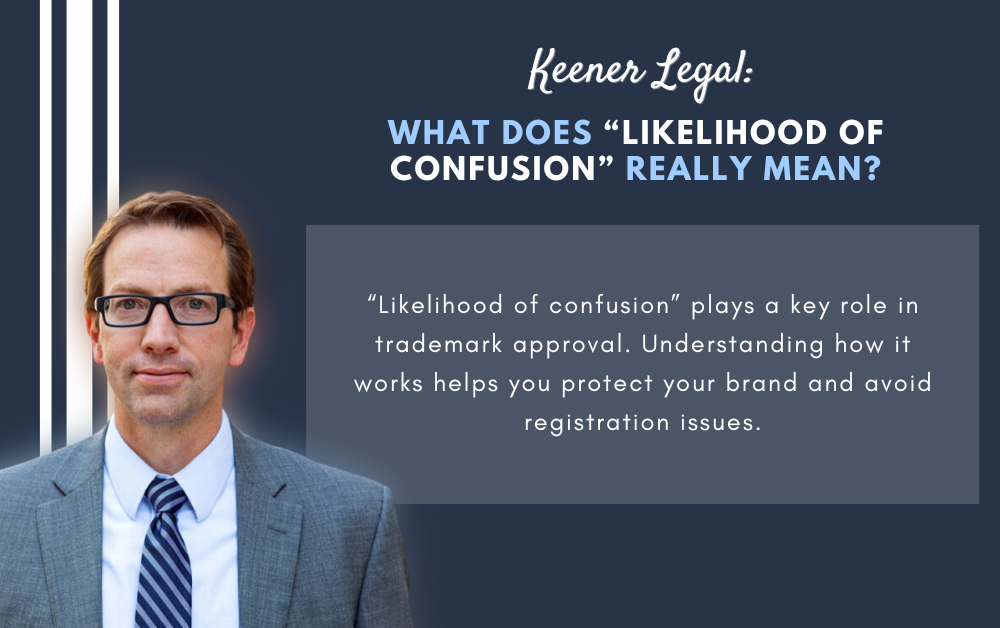
This legal concept is central to U.S. trademark law and one of the primary reasons the United States Patent and Trademark Office (USPTO) refuses to register new trademarks. But what exactly does “likelihood of confusion” mean? And how can you avoid it?
Let’s unpack this important piece of trademark law and explore how it applies to business owners, especially those navigating multiple brands, related companies, or expanding into new markets.
What Is “Likelihood of Confusion”?
At its core, likelihood of confusion refers to the possibility that consumers might believe two products or services come from the same source—even if they don’t. It doesn’t require two trademarks to be identical. In fact, many cases involve marks that only sound alike, look similar, or convey a comparable meaning.
The standard exists to protect consumers, not just businesses. It helps people make informed choices by preventing confusion caused by deceptively similar brands. If a customer buys a product thinking it came from one company when it really came from another, that’s a problem. The law prevents that confusion by restricting how closely trademarks can resemble each other in the marketplace.
Section 2(d) of the Trademark Act
This concept is formally established in Section 2(d) of the Lanham Act (also known as the Trademark Act). Under this rule, the USPTO must refuse registration of a trademark if it is:
“likely, when used on or in connection with the goods of the applicant, to cause confusion, or to cause mistake, or to deceive.”
This means that even if your proposed trademark is unique in your eyes, it could be rejected if an examining attorney finds that it’s too close to a previously registered mark—especially if the marks are being used on similar or related goods or services.
When you apply for a trademark, an examining attorney will conduct a comprehensive search of existing registrations and assess whether your mark might create confusion in the marketplace. If they find a conflict, they’ll issue an Office Action, and unless you can overcome their objections, your application could be denied.
How Does the USPTO Determine Likelihood of Confusion?
To assess whether confusion is likely, the USPTO uses a multi-factor test known as the DuPont Factors, from the 1973 case In re E. I. du Pont de Nemours & Co. These factors guide the examiner’s evaluation, though not all are relevant in every case. Here are some of the most commonly considered:
1. Similarity of the Marks
The marks are examined in their entirety—including sound, appearance, and commercial impression. Even if a mark looks different, if it sounds the same or has a similar meaning, it could raise red flags.
2. Similarity of Goods or Services
If the goods or services are closely related, the risk of confusion increases. For example, “Skyline Coffee” and “Skyline Tea” may operate in slightly different markets, but the overlap in product category could still confuse consumers.
3. Trade Channels and Marketing Methods
The USPTO will consider whether the products are sold in the same places (e.g., online, retail stores) or marketed in the same way.
4. The Strength of the Prior Mark
If the earlier trademark is well-known or “famous,” the bar is higher for what counts as a conflicting mark.
5. Actual Confusion
Although not required, any documented evidence that consumers have actually confused the marks can strongly support a finding of likelihood of confusion.
6. Consumer Sophistication
If the average buyer in the industry is highly knowledgeable, there’s less chance of confusion. But for general consumer goods, the standard assumes a typical, not overly cautious buyer.
These factors are not evaluated in isolation—they are weighed together to form a holistic view of whether confusion is likely in the mind of the average consumer.
When the Companies Are Related: A Deeper Legal Question
Many business owners believe trademark issues automatically resolve when two entities belong to the same corporate family, such as a parent company and its subsidiary. But that’s not always the case.
The Wella Case: A Landmark Ruling
A key example is In re Wella A.G., a legal case that clarified how related companies are treated in trademark law.
In this case, Wella A.G., a German company, owned most of the stock in Wella U.S., its American subsidiary. Both companies used the “WELLA” trademark on various hair care products. When Wella A.G. applied to register a new trademark in the U.S., the USPTO initially refused the application under Section 2(d), claiming that the mark was confusingly similar to an existing one held by Wella U.S.
The case was eventually reviewed by the Court of Appeals for the Federal Circuit, which remanded it back to the Trademark Trial and Appeal Board (TTAB) with important instructions.
The key takeaway? A legal relationship between companies is not, by itself, enough to eliminate confusion. The court made clear that what really matters is whether there is a “unity of control” over the trademarks.
Here’s what the TTAB stated in its ruling:
“Control and source are inextricably linked. If, notwithstanding the legal relationship between entities, each entity exclusively controls the nature and quality of the goods to which it applies one or more of the various ‘WELLA’ trademarks, the two entities are in fact separate sources.”
However, in the Wella case, a declaration by an executive stated that Wella A.G. controlled the trademark usage in the U.S. That evidence confirmed the products came from a single source, leading to approval of the trademark.
Real-World Implications for Your Brand
Understanding the likelihood of confusion isn’t just for lawyers—it’s vital for entrepreneurs, marketing teams, and brand managers.
Here’s why it matters:
- You could spend months building a brand, only to have it rejected by the USPTO.
- Even if your name is clever or meaningful, if it sounds like a competitor’s, it could land you in legal trouble.
- Related entities in your organization must be able to prove unity of control to avoid confusion issues when sharing brand elements.
- A registered trademark doesn’t guarantee you’ll avoid infringement suits—it just gives you a stronger footing.
Expanding into a new product line, launching a second company, or acquiring another brand? How you structure and use your trademarks plays a bigger role than you might realize.
How Keener Legal Can Help
At Keener & Associates, P.C., we specialize in helping clients navigate the trademark registration process, respond to Office Actions, and structure their branding across multiple legal entities in a way that complies with trademark law.
We know how to present evidence of unity of control, craft arguments to overcome Section 2(d) refusals, and protect your business from potential conflicts before they arise.
Whether you’re a startup filing your first application or a multi-brand enterprise facing a complex refusal, we can guide you every step of the way.
Ready to Talk Trademarks?
“Likelihood of confusion” might sound like a vague legal term, but it’s one of the most important concepts in U.S. trademark law. Understanding how it works—and how it applies to your business—is the first step toward building a strong, legally sound brand.
The takeaway? Trademark law doesn’t just protect your logo—it protects your relationship with your customers. And when it comes to protecting that relationship, every detail counts.
Whether you’re facing a Section 2(d) refusal, launching a new brand, or need to ensure consistent trademark use across your company, Keener Legal can guide you through every step.
Schedule a consultation today at keenerlegal.com or call us directly at 1-312-945-8540.