

If you’ve developed a new product, one of the first questions you may ask is how to protect it. Should you apply for a utility patent, a design patent, or a trademark? While these forms of intellectual property all provide legal protection, they protect very different aspects of an invention.
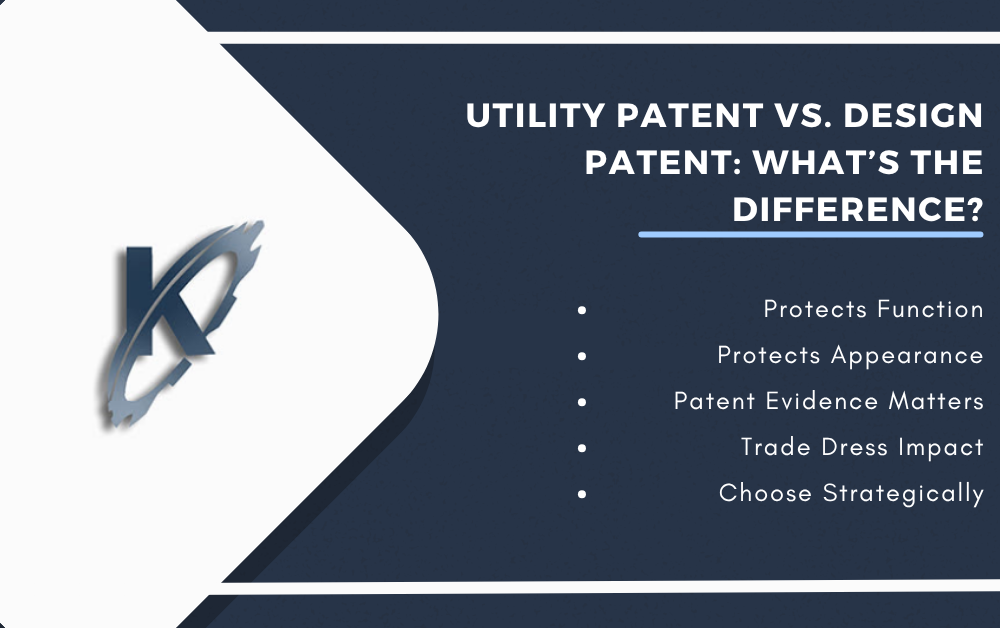
One of the most common points of confusion is the difference between a utility patent and a design patent. A utility patent protects how an invention works, while a design patent protects how it looks. Understanding this distinction is important for inventors, entrepreneurs, and business owners who want to build a strong intellectual property strategy.
The distinction also matters when pursuing trademark protection. The type of patent associated with a product can influence how the U.S. Patent and Trademark Office (USPTO) evaluates trademark and trade dress applications.
In this guide, we’ll explain the differences between utility patents and design patents, how each affects trademark law, and how to determine which type of protection may be right for your business.
What Is a Utility Patent?
A utility patent protects a new and useful invention. Under U.S. patent law, utility patents may cover:
- Processes
- Machines
- Articles of manufacture
- Compositions of matter
- Improvements to existing inventions
Unlike trademarks, which identify the source of goods or services, utility patents protect how an invention functions.
If a product contains a new mechanism, improves efficiency, solves a technical problem, or performs a unique function, it may qualify for utility patent protection.
Utility patents generally provide protection for 20 years from the filing date, assuming maintenance requirements are met.
Common Examples of Utility Patents
Utility patents often protect inventions such as:
- Medical devices
- Manufacturing equipment
- Mechanical tools
- Consumer products with innovative features
- Industrial machinery
- Specialized product components
The focus is always on the invention’s usefulness rather than its appearance.
What Is a Design Patent?
A design patent protects the ornamental appearance of a product rather than how it functions.
Instead of protecting mechanical operation or utility, a design patent covers the visual characteristics of an article of manufacture. This might include:
- Shape
- Surface ornamentation
- Decorative configuration
- Unique visual design
The design must be new, original, and ornamental.
Unlike utility patents, design patents do not protect how a product works.
Design patents generally provide protection for 15 years from the date they are granted.
Common Examples of Design Patents
Design patents frequently protect:
- Decorative bottle shapes
- Furniture designs
- Consumer electronics
- Product packaging
- Jewelry
- Lighting fixtures
- Household products
The goal is to protect a product’s distinctive appearance rather than its functionality.
Utility Patent vs. Design Patent: The Key Differences
Although both types of patents protect inventions, they serve very different purposes.
| Utility Patent | Design Patent |
|---|---|
| Protects functionality | Protects appearance |
| Covers how a product works | Covers how a product looks |
| Based on useful inventions | Based on ornamental designs |
| Focuses on performance | Focuses on visual design |
| Often affects trademark functionality analysis | May support arguments that a design is ornamental |
Choosing the correct type of patent depends entirely on what makes your product unique.
If the innovation lies in the way the product performs, a utility patent may be appropriate. If the innovation is the product’s appearance, a design patent may provide the better option.
Why Utility Patents Matter in Trademark Law
Utility patents play an important role in trademark law because they often become evidence in functionality determinations.
The Supreme Court has explained that a utility patent is strong evidence that the features described in the patent are functional. When a business later seeks trademark or trade dress protection for those same features, the USPTO may view the patent as evidence that the design exists because it serves a useful purpose rather than identifying the source of the product.
This creates a significant challenge for applicants seeking trademark protection.
If a utility patent claims the same product features that are presented as trade dress, the applicant carries a heavy burden of proving those features are not functional.
Example
Imagine a company invents a screwdriver with a uniquely shaped handle that provides greater grip and torque.
The company obtains a utility patent explaining how the handle design improves performance.
Years later, the company attempts to register the handle shape as trade dress.
Because the utility patent explains the functional advantages of the handle, the USPTO may determine that the design cannot function as a trademark. The design exists because it improves performance, not because consumers recognize it as a source identifier.
How Design Patents Affect Trademark Applications
Design patents generally have the opposite effect.
Because they protect ornamental rather than functional features, they may support an argument that a design is non-functional.
However, a design patent does not automatically guarantee trademark protection.
The USPTO still considers all available evidence when evaluating a trademark application. A design patent is only one factor in the analysis and may be outweighed by evidence showing that the product design serves a functional purpose.
Example
Suppose a beverage company develops a uniquely shaped bottle with decorative curves and receives a design patent for its appearance.
Later, the company seeks trademark protection for the bottle shape.
The design patent may support the argument that the bottle is ornamental. However, if evidence shows the curves improve grip or reduce manufacturing costs, the USPTO may still determine that the overall design is functional.
Each application depends on its own facts and evidence.
Can You Have Both a Patent and a Trademark?
Yes.
Many successful businesses own multiple forms of intellectual property covering different aspects of the same product.
For example, a company might have:
- A utility patent protecting a new mechanical invention
- A design patent protecting the product’s ornamental appearance
- A trademark protecting the brand name
- A trademark protecting the company logo
- Trade dress protecting distinctive packaging
Each form of protection serves a different purpose.
Using them together can create a much stronger intellectual property portfolio than relying on one type of protection alone.
What Happens When a Patent Expires?
Patents provide protection for a limited period of time.
Once a utility patent expires, the functional invention generally enters the public domain. Competitors are typically free to use the functional aspects disclosed in the patent.
However, the expired patent may still be relevant in trademark law.
The USPTO can continue to consider an expired utility patent as evidence that certain product features are functional when evaluating trade dress or trademark applications.
Trademark rights, on the other hand, may continue indefinitely as long as the trademark remains in use and the necessary maintenance requirements are met.
Common Misunderstandings About Utility and Design Patents
Does a Utility Patent Prevent Trademark Protection?
Not automatically.
A utility patent creates strong evidence that certain product features are functional, but the USPTO still evaluates the specific design being presented for trademark protection.
Does a Design Patent Guarantee Trademark Rights?
No.
A design patent protects ornamental features, but trademark applicants must still satisfy the requirements for trademark registration, including demonstrating that the proposed mark functions as a source identifier.
Which Type of Patent Is Better?
Neither is inherently better.
The right choice depends entirely on what you are trying to protect.
If your innovation is functional, a utility patent may be appropriate.
If your innovation is primarily visual, a design patent may offer stronger protection.
Some businesses ultimately benefit from pursuing both.
Choosing the Right Protection for Your Business
Before filing any intellectual property application, ask yourself:
- Is my innovation functional or ornamental?
- What makes my product unique?
- Do I want to protect how it works or how it looks?
- Will I eventually seek trademark protection?
- Should multiple forms of intellectual property protection be considered?
These questions can help shape a long-term strategy that protects both innovation and branding.
How Keener Legal Can Help
Choosing the right intellectual property protection is not always straightforward. Filing the wrong type of application or overlooking trademark implications can create unnecessary delays and expense.
Keener Legal helps businesses:
- Evaluate intellectual property strategies
- Analyze functionality issues
- Prepare trademark applications
- Address trade dress concerns
- Respond to USPTO Office Actions
- Protect valuable brands and product designs
Build the Right Intellectual Property Strategy
Whether you’re launching a new product or expanding an existing brand, Keener Legal can help you determine whether a utility patent, design patent, trademark, or combination of protections best fits your goals.
Contact Keener Legal today to discuss your intellectual property strategy and protect your innovations before bringing them to market.
Conclusion
Utility patents and design patents both provide valuable legal protection, but they protect different aspects of an invention. Utility patents focus on how a product works, while design patents protect how it looks.
That distinction becomes especially important when trademark protection is part of your long-term business strategy. Utility patents may provide strong evidence that a product feature is functional, while design patents may support arguments that a feature is ornamental. Understanding these differences before filing can help you choose the right form of protection and avoid costly intellectual property mistakes.
If you’re unsure which type of protection is appropriate for your product, working with an experienced intellectual property attorney can help you make informed decisions and build a stronger, more comprehensive protection strategy.
Not sure whether your product needs a utility patent, design patent, trademark, or trade dress protection? Keener Legal can help you evaluate your options and build an intellectual property strategy that protects both your innovation and your brand. Contact Keener Legal today to get clear guidance before you file.