

In today’s collaborative business world, joint ventures, licensing deals, and corporate groups often share responsibility for managing or using the same brand name. But from a legal perspective, can multiple entities legally own the same trademark?
The short answer is: yes, under specific conditions. “U.S. trademark law, governed by the Lanham Act, requires that a trademark clearly identify a single source of goods or services. “The ‘single source’ standard ensures consumers aren’t confused about who stands behind the brand—even when multiple businesses are involved.
Let’s explore when shared trademark ownership is legal, how the USPTO evaluates it, and how to avoid a Section 2(d) refusal.
Understanding Trademark Ownership
A trademark is a word, phrase, symbol, or design that identifies and distinguishes the source of goods or services. Trademarks build brand recognition and consumer trust. That’s why trademark ownership is strictly regulated to ensure a single source maintains the brand’s quality and reputation.
Under Section 2(d) of the Lanham Act, the U.S. Patent and Trademark Office (USPTO) may refuse a registration if the mark is confusingly similar to one already registered for related goods or services. This refusal aims to prevent consumer confusion and protect the public from assuming two similar marks originate from the same source when they do not.
What Does “Single Source” Mean in Trademark Law?
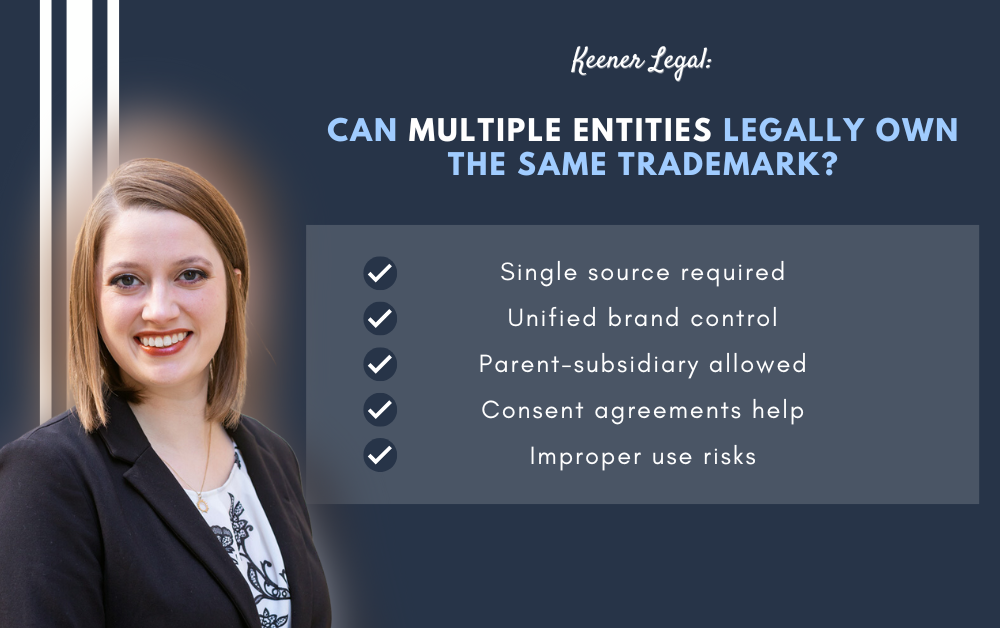
Even if multiple companies use a mark, they must function as one “single source” in the eyes of the law. This doesn’t mean just sharing profits or cooperating casually—it means showing unity of control over the mark’s use, quality, and reputation.
This concept becomes critical when an applicant responds to a Section 2(d) refusal by claiming that the entities involved (the applicant and the registrant) are essentially one and the same. That’s where the Wella precedent comes into play. According to this legal standard, the USPTO won’t evaluate a business relationship between the parties unless the applicant asserts that they are legally or operationally unified.
When Shared Ownership Can Work
There are legitimate scenarios where two or more entities can be seen as a single source:
- Parent-Subsidiary Relationships: A parent company may own a mark, while a wholly owned subsidiary uses it, provided there’s tight control and oversight.
- Affiliated Companies Under Common Ownership: If two companies are owned by the same parent and operate under a unified brand strategy, joint trademark use may be permitted.
- Joint Ventures: When structured carefully, joint ventures can share rights to a trademark if the venture operates as a single brand with centralized control.
The key in all these situations is proving unity of control. This means showing that decisions about how the trademark is used, managed, and protected come from one central authority—even if multiple companies are involved.
Applicants can also resolve Section 2(d) conflicts by:
- Providing consent agreements between the parties.
- Assigning the trademark to one entity that licenses it to others.
USPTO’s Role and the §2(d) Refusal
When you apply for a trademark, the examining attorney compares it to existing marks. If your mark is too similar to another one registered for related goods or services, the USPTO may issue a Section 2(d) refusal.
Importantly, the USPTO will not evaluate whether your company has a connection to the registrant unless you bring it up. The burden is on the applicant to assert a relationship and argue that the entities are a “single source.”
To overcome a refusal, the applicant must:
- Clearly explain the relationship between the entities (parent/subsidiary, affiliates, etc.).
- Submit evidence of centralized control over the trademark.
- Provide legal agreements that demonstrate shared use does not confuse consumers.
- Or, simplify ownership by assigning the trademark to a single party.
Risks of Attempting Shared Ownership Without Proper Structure
Trying to co-own a trademark without the legal foundation for a single source can create serious issues:
- Consumer Confusion: If it’s unclear who controls the brand, the USPTO will likely issue a refusal.
- Vulnerability to Disputes: If partners fall out or ownership changes, the trademark could become a liability.
- Weak Enforcement Rights: Courts may hesitate to uphold a trademark if ownership or usage rights are unclear.
Unstructured sharing may also result in lost rights, especially if neither party exercises quality control or oversight—key requirements for maintaining trademark validity.
Practical Tips for Business Owners
If you operate in a structure where multiple companies might be involved in trademark use, keep these tips in mind:
- Centralize Ownership: Assign the trademark to a parent company or holding entity to keep things clean.
- Use Licensing Agreements: If affiliates or subsidiaries use the mark, document it with a formal license.
- Maintain Quality Control: Ensure that one party is clearly in charge of how the mark is used and monitored.
- Avoid Casual Sharing: Don’t treat trademarks like a shared resource unless you have legal backing to do so.
Most importantly, consult an intellectual property attorney to structure things correctly from the start.
Shared Ownership Requires Strategic Control
Yes, multiple entities can legally share a trademark—but only under strict conditions that demonstrate they operate as a single source. Without this legal and operational unity, the USPTO may reject an application due to likelihood of confusion under §2(d) of the Lanham Act.
To avoid that outcome, structure your business relationships carefully, maintain centralized control of the brand, and be proactive in presenting your case to the USPTO. A strong legal strategy will protect your brand—and prevent costly trademark disputes down the line.
Need help navigating trademark ownership or overcoming a §2(d) refusal?
At Keener Legal, we specialize in helping businesses protect their intellectual property with smart, strategic legal solutions. Whether you’re managing trademarks across multiple entities or facing USPTO challenges, we’re here to guide you.